
The training for the profession of illustrator does not rely on any mandatory diploma in France. In practice, the vast majority of professional illustrators currently working have attended a specialized school with in-person classes, according to the job description updated by the Intuit Lab school. This gap between the prevailing discourse on self-taught learning and the reality on the ground deserves attention.
Real-time correction and observational drawing: what the screen cannot replace
An in-person drawing class is based on a precise pedagogical mechanism: real-time gestural correction. The instructor observes the line, identifies an error in proportion or value, and intervenes physically on the medium or next to it. This immediate feedback impacts motor memory in a way that a written comment under a digital file does not replicate.
Observational drawing, a cornerstone of any illustration training, requires a direct relationship with the object, light, and volume. Drawing a live model in a studio shared with other students forces one to deal with spatial constraints, imposed angles, and limited time. These conditions forge reflexes that working alone in front of a graphic tablet does not train in the same way.
Choosing to become an illustrator through in-person training allows one to benefit from continuous technical guidance, where a video tutorial freezes the demonstration without adapting to the gesture of each learner.
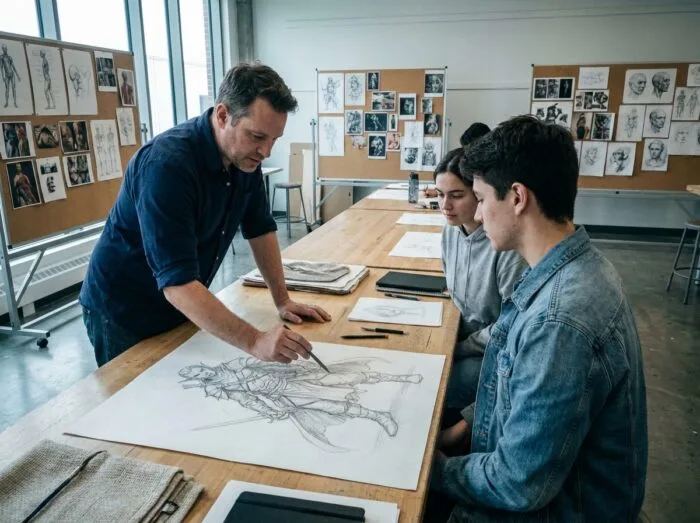
Art school courses and building a professional network
An illustrator’s professional network is rarely built after training. It is woven during classes, in group projects, end-of-year juries, and partnerships with external clients. Classmates become art directors, graphic designers, and publishers. These connections, formed over the duration of a shared curriculum, yield recommendations and commissions many years later.
Specialized schools also organize meetings with active professionals: editorial illustrators, comic book authors, graphic designers. These in-class interventions allow for direct exchanges, feedback on portfolios, and sometimes offers for internships or collaborations.
What work-study changes for illustration students
Since 2023-2024, several visual arts schools offer to finance the final years of the curriculum through apprenticeships. This development also applies to illustration and graphic design programs. Work-study reduces the cost of studies while anchoring learning in a real professional context, with concrete tasks at an employer.
For an illustration student, alternating between the classroom and a studio or publishing house creates a constant back-and-forth between theory and practice. The instructor at school can then adjust their teaching to the difficulties encountered in the workplace, something a 100% online program does not allow.
In-person or online illustration training: concrete selection criteria
The debate between in-person and online formats is not just a matter of personal preference. Several technical criteria differentiate the two formats for a future illustrator.
- Access to equipment: a school provides printing spaces (screen printing, risography), libraries of visual references, and workstations equipped with licensed professional software, which represents an investment that few self-taught individuals can afford alone.
- Confrontation with collective feedback: presenting one’s work in front of a group and receiving varied critiques develops the ability to defend an artistic stance in front of a client or publisher.
- Time structure: a fixed schedule with regular submissions imposes a production discipline that the more flexible online format often leaves to the learner’s own will.
In-person training does not exclude digital tools. Most school curricula integrate the mastery of vector drawing, photo editing, and layout software. The classroom simply adds a layer of learning that digital alone does not cover: gesture, shared observation, physical constraint.

Illustration diploma: a signal for clients
The profession of illustrator does not impose any regulatory diploma. A client or publisher can commission work from any professional whose portfolio convinces them. In practice, a diploma from a recognized school serves as a signal of competence, especially early in one’s career when the portfolio is still thin.
Entrance exams for public art schools (DNA, DNSEP) or admissions to specialized private schools filter candidates based on their technical skills and visual culture. Having passed this selection reassures a client about the professional’s basic level, even before looking at their work.
Status of artist-author and post-school transition
The majority of illustrators work under the status of artist-author, which involves a specific declaration and tax obligations distinct from a traditional micro-enterprise. Schools that provide in-person training generally dedicate modules to these administrative aspects: invoicing, transfer of copyright, publishing contracts. A self-taught individual often discovers these topics late, sometimes after making mistakes on their first contracts.
The classroom remains, for illustration training, a setting where drawing technique, visual culture, digital practice, and the administrative realities of the profession intersect. In-person training does not guarantee professional success, but it structures a foundation that alternative paths reconstruct more slowly and less comprehensively.