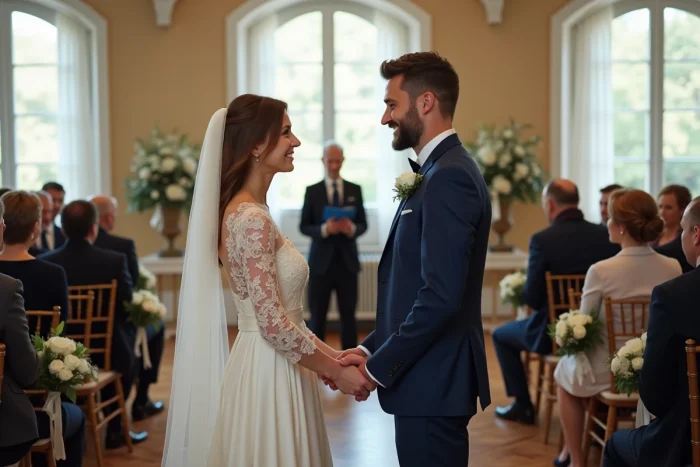
A republican wedding refers to a secular ceremony, meaning a symbolic celebration of a couple’s commitment, without a religious framework and without legal value. The civil ceremony remains the only legally recognized act in France. The secular ceremony, on the other hand, is constructed freely: location, texts, music, rituals, everything is decided by the couple. This total freedom is also what makes the exercise delicate, as without imposed structure, the risk of producing a hollow or disjointed ceremony is real.
Building a narrative thread rather than stacking sequences
Most secular ceremonies follow a predictable pattern: musical entrance, officiant’s speech, readings by loved ones, exchange of vows, symbolic ritual, exit. This sequence works, but it often results in a series of moments that are disconnected from one another. Each speaker prepares their text in isolation, and the result resembles a succession of independent acts.
Why not start from a single guiding thread? A theme, a question, a word that runs through the entire ceremony. If the couple unites around the idea of “building together,” each speech can approach this angle from a different perspective: a friend recounts how the couple renovated their home, a parent discusses how they overcome obstacles.
The vows, in turn, speak of what they want to build. A narrative thread transforms isolated speeches into a coherent story.
To achieve this, simply convey this guiding thread to each speaker in advance. The officiant then plays the role of narrator who connects the speeches, rather than just being a facilitator who passes the microphone.
You will find additional guidelines on the sequence and customization choices in the guide dedicated to the republican wedding on Help Mariage, which details the preparation steps.
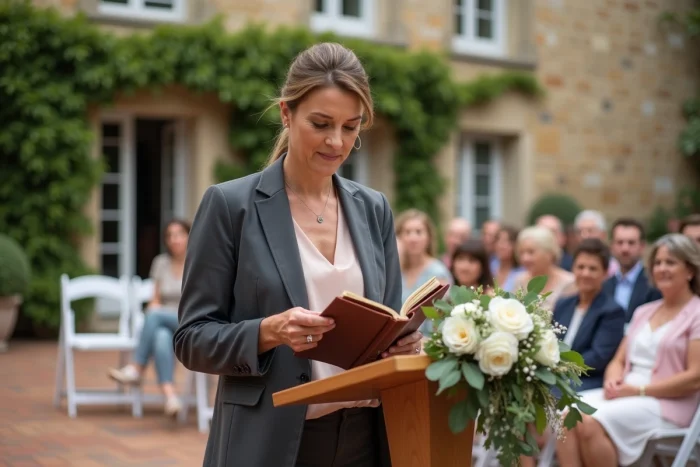
Secular ceremony officiant: the casting that changes everything
The officiant is the backbone of the ceremony. Two main options are available: entrust this role to a loved one or hire a professional officiant. The choice of officiant determines the pace and tone of the entire celebration.
A loved one knows the couple’s story, their codes, their humor. They bring an authenticity that is hard to replicate. However, they generally have no experience speaking in public for an hour in front of several dozen people. Stress, speaking too quickly, poorly managed pauses can turn a beautiful text into an awkward moment.
A professional officiant masters the rhythm, transitions, and management of unforeseen events. They know how to regain attention when it wanes and calibrate the duration of each segment. The downside: they do not know the couple intimately and will have to reconstruct their story from preparatory interviews.
Combining both approaches
An effective solution is to designate a loved one as the main officiant while having their text reviewed and structured by a professional. Some officiants even offer support without being present on the big day. The loved one retains their spontaneity but benefits from a solid framework to manage time and transitions.
Symbolic rituals: focusing on a single strong gesture
Sand ritual, ribbon ritual, candle ritual, tree ritual, sealed wine, hot stones… The list of available rituals grows each year. Multiplying rituals dilutes their impact instead of strengthening it. When three or four symbolic gestures follow one another, none truly leaves a lasting impression.
Are you hesitating between several rituals? Ask yourself a simple question: which one tells something specific about your couple, and not just about “love in general”?
- The sealed wine ritual (an opened bottle for a specific wedding anniversary) works if the couple has a real relationship with wine, patience, and the passage of time.
- The ribbon-tying ritual makes sense if the couple wants to symbolize a physical bond, a concrete attachment.
- The participatory ritual (each guest places a word, a stone, an object) suits couples who want to actively include their loved ones in the ceremony.
One well-chosen and well-explained ritual is worth more than three gestures strung together without context. The officiant should take the time to explain to the guests why this ritual was chosen and what it represents for the couple. Without this context, the gesture remains decorative.
Coordination of the sequence on the big day: managing real-time
Logistical coordination is the most underestimated aspect of organizing a secular ceremony. On paper, the sequence seems fluid. In practice, discrepancies can quickly arise.
A speech planned for five minutes lasts nine. A speaker forgets their text and improvises. The transition music does not play at the right moment. Without precise timing and a stage manager, the ceremony easily exceeds the planned duration.
Preparing a ceremony conductor minute by minute
The conductor is a document that lists each sequence with its target duration, the name of the speaker, the transition signal, and the associated music. Here are the elements to include:
- The exact order of speeches, with a maximum duration communicated to each speaker in advance.
- The musical transitions: which piece, launched by whom, at what signal (a gesture from the officiant, the end of a specific phrase).
- A designated technical manager (often a witness or a service provider) who manages sound diffusion and any visual aids.
- A safety margin of a few minutes at the end of the ceremony to absorb overruns without disrupting the following events (cocktail, photos).
This document does not need to be complex. A simple sheet shared between the officiant and the technical manager is sufficient. The goal is for everyone to know when to intervene without having to improvise.
The difference between a touching secular ceremony and one that drags on rarely lies in the content of the texts. It lies in the fluidity of the transitions, the well-placed silence between two speeches, and the officiant’s ability to sense when the guests’ attention begins to wane to regain the rhythm.