You order a dress or jeans from Asos, the package arrives in two days, and the label sometimes indicates a country of manufacture, sometimes nothing legible. Knowing where a garment purchased online actually comes from today requires more than just a glance at an inner seam. Asos, the British giant of online fashion, lists thousands of items from third-party brands and its own line, with supply chains spread across multiple continents.
Blockchain Traceability: Checking Provenance Beyond Asos Labels
The label sewn into a garment rarely provides the complete journey of the fabric. It mentions the country of final assembly, not where the fiber was spun or where the textile was dyed. For a brand like Asos, which distributes both its own collections and those of partner brands, this opacity multiplies.
Blockchain-based traceability tools are beginning to offer an alternative. The principle is simple: each step of production (spinning, weaving, manufacturing, shipping) is recorded in an unalterable digital ledger. A consumer can then scan a QR code on the item and trace back the supply chain.
To better understand where Asos garments are made, this type of technology goes beyond the official statements of brands. It allows for a comparison between what is claimed and what is actually documented at each link.
Blockchain does not guarantee ethics, but it makes lying more costly. If a supplier claims a factory in Portugal while the fabric comes from another country, the inconsistency appears in the data chain. A few platforms specializing in fashion are already testing this model, even though Asos has not yet integrated a publicly accessible blockchain system on its product pages.

Asos Subcontracting Factories: What Recent Reports Reveal
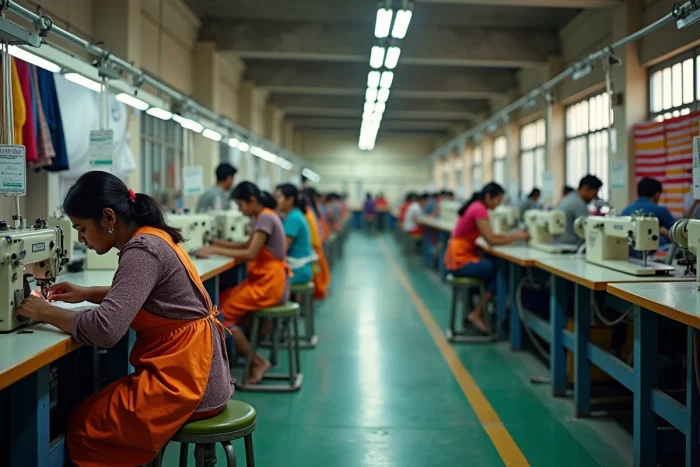
The majority of garments sold under the Asos brand are assembled in Asia. Bangladesh, India, Turkey, and China are among the countries regularly cited in reports from independent organizations.
In March 2026, Clean Clothes Campaign published its report “Supply Chain Realities 2026.” Testimonies from Bangladeshi workers subcontracted by Asos describe a significant decline in real wages adjusted for inflation since 2024, despite nominal wage increases. In other words, paychecks show a higher amount, but purchasing power is declining.
In November 2025, Amnesty International documented violations of union rights in factories supplying Asos, Adidas, H&M, Gap, and Inditex in South Asia. The report highlights the silencing of workers’ collectives and restrictions on union freedom, twelve years after the Rana Plaza disaster.
What Consumers Can Verify
Asos publishes a partial list of its suppliers, but without details on lower-tier subcontractors. Here’s what an attentive buyer can do:
- Check the label of the received product to identify the country of final assembly, then look up that country in the reports from Clean Clothes Campaign or Amnesty International to learn about the documented local conditions.
- Verify if the third-party brand sold on Asos has its own transparency policy (some publish their factories, others do not).
- Follow investigations by regulatory authorities, including the British Competition and Markets Authority opened in April 2026 regarding Asos’s environmental claims.
Third-party brands on Asos do not all have the same level of transparency. An Asos Design item and an item from a partner brand may come from factories with very different practices, without the site clearly indicating this.
Greenwashing and CMA Investigation: Asos’s Eco-Responsible Promises Under Pressure
Asos has set ambitious environmental goals. The brand has communicated a target for sustainable materials for its own collections. However, the line between real commitment and marketing remains blurred in fast fashion.
The British CMA opened a formal investigation into Asos’s greenwashing in April 2026. The competition authority is targeting unsubstantiated “sustainable” claims on provenance labels. This investigation is part of a broader movement: the UK had already questioned the environmental communication practices of several online fashion brands.
The problem is not limited to labels. When a site adds an “eco-friendly” filter to its categories, the consumer assumes that the displayed products meet verifiable criteria. However, the criteria vary from one brand to another, and Asos has not always made its own public in detail.
Fast Fashion and Product Data: What’s Missing on Asos Product Pages
You may have noticed that an Asos product page details the textile composition (cotton, polyester, elastane) but almost never mentions the place of manufacture before purchase? This information often only appears on the physical label, once the package is opened.
For responsible purchasing, useful data would include:
- The country of manufacture and, ideally, the name of the factory.
- The proportion of recycled or certified materials, along with the reference of the certificate.
- The social audit score of the supplier, based on a recognized standard.
None of this information is systematically available on Asos product pages. Other, smaller brands are beginning to integrate them. European and British regulatory pressure could accelerate this movement.
Buying on Asos with Awareness: Reflexes to Adopt
Waiting for Asos or any other fast fashion brand to become transparent out of goodwill would be optimistic. Recent advances come mainly from regulators and civil society organizations.
The most effective reflex remains to cross-check sources. A garment sold on Asos may be made in an audited factory or in an undeclared subcontracting workshop. Independent reports are now more reliable than the brands’ “commitment” pages.
Blockchain traceability, if it becomes widespread, will change the game. It will not eliminate abuses, but it will make supply chains readable for anyone who wants to verify. In the meantime, every purchase on Asos or elsewhere in online fashion remains a gamble on the seller’s good faith, unless the buyer does the verification work themselves.