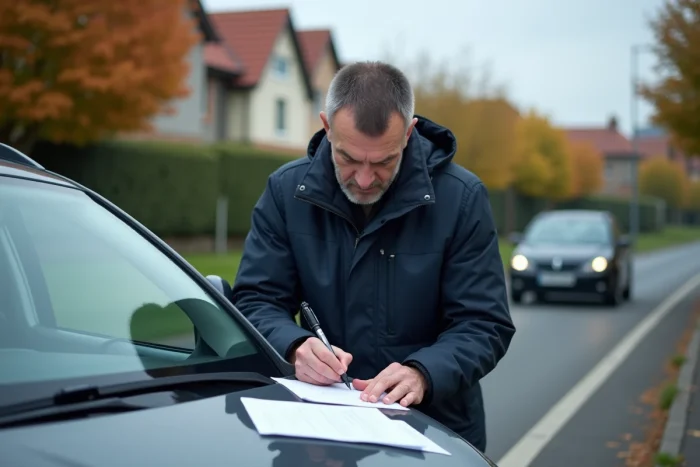
Five working days. This figure allows for no improvisation when it comes to reporting a car accident to your insurance. A strict framework, delineated by the Insurance Code, which leaves little room for hesitation or delay. However, behind this rule, situations vary, and each claim opens up its own set of procedures, requirements, and sometimes complications, especially when the famous report takes time to reach the insurer’s offices.
Legal deadlines: how long do you have to send a report after a car accident?
The legal deadline imposed for submitting the amicable report allows for no approximation. After an accident, each driver is required to adhere to a clear directive: send the report to their insurance within a five working day deadline from the date of the incident. The countdown starts from the moment of the accident, but only working days are counted: weekends and public holidays are excluded.
The question often arises and is never taken lightly: how long to send a report? The answer leaves no ambiguity, codified in black and white in the texts and reiterated in the practical sheet “Maximum deadline for submitting a report after an accident – La Belle Auto.” Exceeding this deadline exposes you to complications: the insurer may reduce or even refuse to cover the accident. Here, administrative rules take precedence over flexibility.
Depending on the nature of the incident, the deadlines vary. Here’s a precise overview of the most common scenarios:
- Material accident: five working days to submit the file to the insurance.
- Theft, fire, glass breakage: two working days, as urgency is paramount.
Filling out the amicable report then becomes a key step. This document specifies the facts, determines each party’s liability, and serves as the starting point for any compensation. Reporting quickly, on time, ensures coverage under good conditions and avoids turning a road incident into an administrative nightmare. A report sent late: and the spiral of complications begins.
What steps to take with your insurer for a successful declaration?
Once the accident occurs, everything happens at the roadside. The amicable report must be written immediately, as it freezes the circumstances of the accident: exact location, description of damages, identity of each driver, contract number. No detail should escape this document, which will serve as the guiding thread for the entire procedure.
Before finalizing your declaration, take the time to review each section. Identify inaccuracies, add missing elements. A snapshot of the intersection, a photo of the damages or the road markings, all of this can make a difference if a disagreement arises with the insurance. And always, keep a copy of the paper report: it can be useful at any time.
To facilitate the management of your claim, here are the steps to follow:
- Fill out each part of the document, front and back, and have both drivers sign without exception.
- Submit the report to your insurer within the imposed deadlines: five working days, no more, no less.
- Add all relevant documents: photos, testimonies, a diagram of the scene, or even a police report if the situation requires it.
Insurance companies are increasingly accepting electronic submission of the report (scan or photo). Even in this case, keep the original in your files. Don’t forget to include your contract number and briefly recap the facts in your message. The more precise the file, the fewer back-and-forths there will be, and the faster the compensation will be.
A well-organized file, where each element finds its place, streamlines communication and reduces the risk of disputes. A claim handled in haste opens the door to complications and extended timelines.

Practical questions: how to react in case of unforeseen events during the declaration of a car claim?
In reality, accidents never adhere to theory. Injury, tension, witnesses disappearing before leaving their contact details: managing a car claim comes with its share of unpredictability. Yet, the amicable report remains the pivot of the process, even when circumstances become complicated.
When the unexpected occurs, one rule: document everything you can. The contact details of a witness, even reduced to a name and a number, can change everything during the investigation of the file. If the other driver refuses to sign, clearly mention this on the report and fill it out alone, omitting nothing. A unilaterally completed document retains its value in the compensation process.
Unable to fill out the report on-site? Note the essential elements: quick sketch, circumstances, license plate numbers. Gather this information and submit it to the insurance within the regulatory deadline, even if the file remains incomplete initially. A partial report, accompanied by an explanatory note, initiates the process and protects you from a delay in reporting the claim.
To leave nothing to chance, here are the reflexes to adopt:
- Collect all available evidence: photos, testimonies, a copy of a police report if there was an intervention on-site.
- Describe what makes the situation atypical: absent witness, fleeing responsible party, disagreement on versions.
Managing the human aspect without neglecting the method: this is the key to respecting the deadlines for reporting. No room for hesitation: act quickly, document each step, and contact your insurer at the slightest doubt. The slightest administrative misstep can be costly, so it’s best to keep control over every detail.