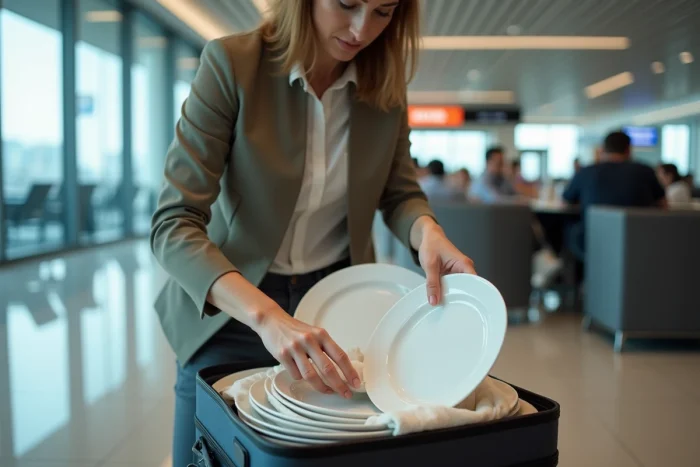
The list of prohibitions keeps growing, and savvy travelers know that the slightest oversight can turn boarding into an obstacle course. Transporting dishes in cabin luggage is a real treasure hunt, where every detail matters, from accepted materials to the slightest suspicious container.
Some carriers outright ban dishes in cabin luggage, while others allow them under very strict conditions. The dimensions of bags, the nature of the items, the presence of materials deemed risky: everything is scrutinized. It is not uncommon to discover, the day before departure, that a certain utensil or empty container could pose a problem at security.
Ignoring these requirements exposes you to unpleasant surprises: unexpected fees, confiscation of valuable items, or even the impossibility of retrieving them at your destination. It is better to know the ins and outs of the regulations in advance and prepare your luggage methodically to pass through security with peace of mind.
What you need to know about cabin and hold baggage rules for dishes
Bringing dishes on board an airplane requires rigor and anticipation. Each airline imposes specific limits: for a tea set, a few plates, or bowls, space is limited in a cabin bag. The maximum dimensions of these bags generally hover around 55 x 35 x 25 cm, but always check the carrier’s specifics. Depending on the class booked, the type of ticket, and internal policy, the allowed baggage allowance varies greatly. If the dishes do not fit within the limits, they will end up in the hold, often at your expense.
Not all materials are accepted. Items that could be misused (knives, metal forks, thick glass dishes) are systematically excluded from cabin baggage. On the other hand, ceramic or porcelain cups, bowls, and plates pass through security more easily, provided they are empty and well-protected. Also, be cautious with lithium batteries: they must remain in the cabin if integrated into an electronic device; placing them in the hold is strictly prohibited for fire safety reasons.
Liquids are not just about bottles. Any container, even empty, can raise the curiosity of security agents. To transport dishes in cabin baggage without hassle, it’s best to anticipate restrictions, choose suitable packaging, and create a precise inventory of what you are bringing. A simple call or email to the airline before the trip can prevent many disappointments once at the airport.
Dishes on the plane: what restrictions apply according to airlines and which items are prohibited?
Each carrier sets its own rules regarding dishes in the cabin. While some everyday items pass through security easily, others are banned without any discussion. For size, weight, and content of baggage, there is no universal standard: it all depends on the airline, destination, and type of ticket.
Here are the key points to remember before packing your bag:
- Cups, bowls, and plates (empty) are generally accepted if the baggage complies with the specified size and weight.
- Sharp objects (knives, metal forks, blades, scissors) are systematically refused.
- Containers with liquid must be limited to 100 ml each, placed in a transparent, resealable pouch. A dish with leftovers or a full teapot will not pass security.
| Allowed items | Prohibited items |
|---|---|
| Cups, bowls, plates (empty) | Knives, forks, scissors, blades |
| Plastic, porcelain, earthenware dishes | Containers holding more than 100 ml of liquid |
Particular vigilance is required for any accessory containing a lithium battery (including some small kitchen appliances). These batteries must always remain in the cabin: their presence in the hold is strictly forbidden. As for camping stoves, even perfectly clean and without fuel, they are often refused at boarding.
Before each departure, take the time to check the updated list of prohibited items on the airline’s website. Security checks are becoming increasingly strict, and presenting dishes in their original packaging remains an advantage for passing through security smoothly.

How to pack and transport your dishes without breakage or unpleasant surprises at the airport
Transporting dishes in cabin baggage is a bit like organizing a meticulous expedition: each piece must be protected, and every space optimized. Start by checking that your bag complies with the dimensions imposed by the airline. A poorly secured glass, a plate laid flat, and the risk of breakage skyrockets. A hard case or a shell suitcase offers better protection: they absorb shocks and limit damage during handling in the airplane.
The original packaging remains the best choice: tailored to each piece, it cushions impacts. If you’ve thrown it away, don’t panic: bubble wrap, thick towels, foam covers, or old sweaters work perfectly. Just make sure to securely position fragile items (glasses, cups, small bowls) in the center of the luggage, surrounded by textiles. Plates, on the other hand, travel best vertically to avoid breaking under the weight of other items.
A few simple precautions make transport safer:
- Keep the bag easy to handle and respect the maximum weight allowed.
- Set aside any sharp metallic objects: knives, forks, or unauthorized accessories have no place in cabin baggage.
- Ensure that each container is perfectly empty: no liquid, even residual, should remain in the transported dishes.
Security checks at the airport have become exceedingly meticulous. At boarding, agents carefully examine each bag: it’s better to be able to present proof of purchase or the original packaging if the dishes appear new. Planning, anticipating, and taking care with packaging: all of this avoids many disappointments and allows you to arrive at your destination with intact dishes and preserved morale.
At the end of the conveyor belt, amidst the rustling of suitcases and boarding announcements, it’s often this attention to detail that makes the difference. It’s better to be proactive than to have to, at the last second, hand over your plates to the hold or see them disappear behind the security counter. A well-prepared trip means arriving without breakage, and sometimes, an intact memory in the bag.