When moving in or deciding to take control of an interior, we often start by accumulating visual references. We come across dozens of identical living rooms, kitchens photographed from the same angle, and the same color combinations appear from one account to another.
Creating a home that reflects your personality requires a different approach: starting from concrete constraints (budget, space, natural light, daily uses) to build an interior that lasts over time.
Mobile walls and modular furniture: thinking of an evolving home
An apartment designed for a couple without children no longer works five years later with a home office and an extra bedroom to fit in. Instead of rearranging every time life changes, we can design the space to transform without heavy renovations.
Agencies like Encore Heureux Architectes have been working for several years on this logic of a repairable and evolving home. The principle: removable partitions, modular furniture that can be reconfigured, reusable materials that can be repurposed elsewhere. The Pavillon de l’Arsenal has documented this trend as an alternative to repeated heavy renovations.
In practical terms, it involves simple choices at the time of furnishing. Favor a freestanding bookshelf rather than a wall-mounted shelf. Install an interior glass partition on rails instead of a drywall wall. Opt for a kitchen plan with separate modules rather than a sealed linear block. You can also discover the Opus Media website to explore room configurations suited to different space and budget constraints.
Feedback varies on this point: some find that removable partitions lack sound insulation, while others consider them sufficient to separate a workspace from a living room. It all depends on the existing structure and the chosen thickness.

Colors and flooring: choices that truly change a room
The effect of flooring on the atmosphere of a room is often underestimated. A light oak floor in a north-facing living room does not produce the same result as a dark tile. Before choosing a wall color, one must first look at what is underfoot and the light that comes in.
Structuring the space with color rather than furniture
A wall painted in a strong hue (forest green, teal, terracotta) is enough to visually delineate an area without adding a partition. In an open living-dining room, painting the wall behind the table in a different tone creates a clear separation that the eye immediately identifies.
For the kitchen, tiles installed as a backsplash produce a similar effect. A small tile format (like zellige) adds texture without overwhelming. A more personal result is achieved by limiting each room to two dominant materials: one for the floor, one for the walls.
Testing before committing
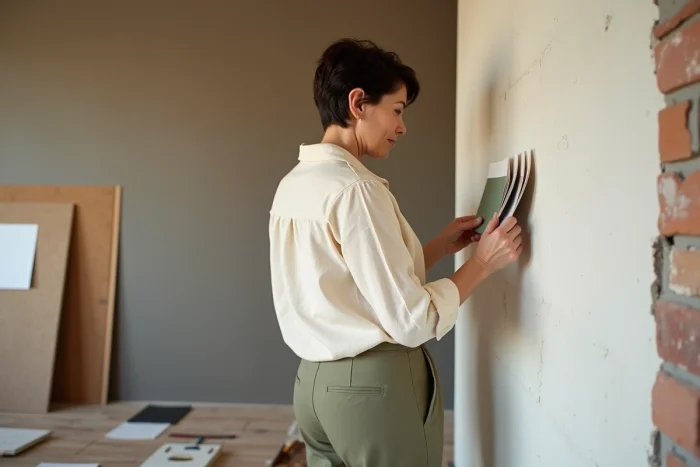
Buying a sample pot and painting a one-meter square on the targeted wall remains the most reliable method. Digital color charts and 3D visualization apps give an idea of the shade, but they do not replicate the effect of natural light at different times. It is advised to leave the sample visible for at least three days, morning and evening, before making a decision.
Interior personalization and well-being: what psychology research shows
Decorating an interior is not just about aesthetics. Research in environmental psychology shows that occupants who freely personalize their homes report greater residential satisfaction and higher emotional well-being than those living in standardized or imposed spaces.
The identified link comes from the feeling of control: being able to choose colors, arrange objects, and hang what one wants on the walls enhances the perception of mastering one’s daily environment. Conversely, tenants of furnished apartments or highly standardized shared accommodations more often report stress related to their living space.
In practice, this means that even small interventions, a personal photo frame, a self-chosen textile, an object brought back from a trip, contribute more to the comfort felt than an expensive designer piece selected from a catalog.

Lighting and living room layout: adjusting light in layers
Interior photos in magazines systematically use multiple light sources and optimized natural lighting. Reproducing this result at home requires working on three levels of light in each room:
- A general lighting (ceiling fixture or pendant) that covers the area without glare, positioned at the center of the main living area
- Ambient lighting (table lamps, string lights, adjustable wall sconces) placed at eye level to create depth in the evening
- Functional lighting (reading lamp near the sofa, spotlight under kitchen cabinets) directed precisely where it is needed
Layering these three types transforms a flat living room into a vibrant space, without touching the furniture or paint. Start with functional lighting (the most useful), then add ambient lighting, and adjust general lighting last.
For the living room, the height of the pendant above the coffee table or dining table makes all the difference. Too high, the light disperses and the space feels cold. Too low, you bump into it and the lighting becomes oppressive. The right position is determined by sitting in your usual spot: the source should not enter your direct line of sight.
An interior that reflects you is not built in a weekend of decor shopping. The most sustainable choices come from your actual habits: where you place your belongings when you come home, which room you use the most, at what time natural light disappears. These everyday markers guide each layout decision better than an inspiration board.