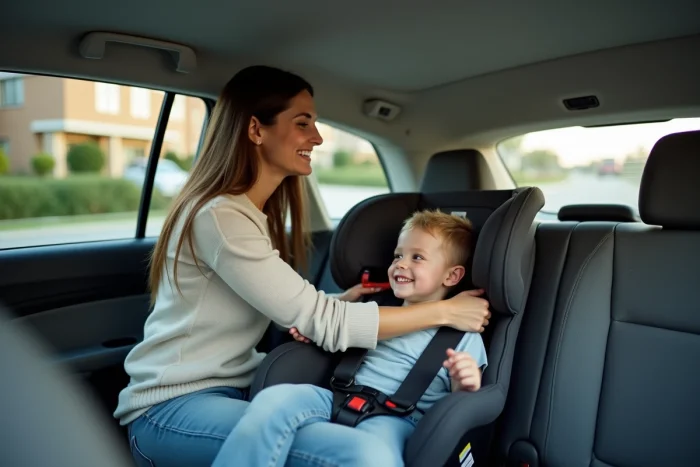
No European approval guarantees total safety in the event of a collision, even for the latest car seats. However, some models show superior performance in independent tests, sometimes contradicting official rankings.
The price differences between models of the same brand do not always reflect notable differences in comfort or protection. Faced with the abundance of options, the choice relies on specific criteria and the consultation of verified reviews.
Why Nania car seats are increasingly appealing to families
Behind the name Nania is the company TeamTex, founded by Yves Nania. This French manufacturer focuses entirely on proximity: design, production, distribution, everything happens in France. The brand specializes in accessible baby equipment without sacrificing quality. What stands out first is the price: a low entry ticket made possible by a local and controlled manufacturing chain, far from low-cost productions from elsewhere. Each seat comes out of French factories, a rarity in this largely globalized market.
The range covers all needs: from newborns to older children, for daily or occasional use. Versatility, ease of installation, and the ability to accompany growth are what families appreciate. Many use a Nania seat for short trips or as a booster seat at grandparents’ houses. This modularity fits the reality of many households.
TeamTex also shows a commitment to reducing its environmental impact, whether in raw material management or logistics. This reasoned approach appeals to more and more parents who are mindful of their consumption. But it is the value for money that truly builds loyalty, reinforced by overall positive customer reviews. The strengths often mentioned include: robustness, easy maintenance, and availability of spare parts. To go further, our review of Nania car seats offers a concrete analysis of reliability, model evolution, and their adaptation to real use.
Comparison of flagship models: strengths, limitations, and user reviews
The Nania range extends from infant seats to boosters for older children. Some models stand out for their ability to evolve with the child or for their attractive price. Here are the main models and what to expect from them:
- Nania Cosmo Pop (group 0/1, 0-18 kg): installation via three-point belt, four reclining positions, adjustable five-point harness. Families appreciate its simplicity and cost. However, even with the reducer, the support for toddlers may prove insufficient.
- Nania Eno 360° (group 0+/1/2/3, 0-36 kg): rotating, Isofix and Top Tether fixation, adjustable headrest, double side protection. This versatile model is liked for its 360° rotation, which makes daily life easier. Users highlight its ease of use and comfort, without noting any significant flaws.
- Nania Trio (group 0/1/2, 0-25 kg): three-point belt, five-point harness, reducer for smaller children. The price is attractive, but some mention limited comfort on long journeys, especially for medium or large-sized children.
- Nania Beone (group 0+, 0-13 kg): rear-facing shell, side protection, five-point harness, removable cover. Many praise its lightness, interior space, and use from birth. Easy to transport, it adapts well to the morphology of babies.
Each model displays the ECE R44/04 approval. Nania car seats are assessed on safety, comfort, and ease of maintenance. Feedback sometimes highlights limited padding or imperfect adjustment for smaller children, but they also emphasize robustness and the ease of replacing parts.

What criteria to prioritize for confidently choosing your Nania car seat
Choosing a Nania car seat is not a matter of chance. It involves the child’s safety and daily practicality. The first step is to identify the appropriate group: each model is aimed at a distinct age, weight, and height range. To make the right choice, one must consider the child’s current size while also anticipating future growth if the seat is to be used for a long time.
Here are the criteria to examine before making a decision:
- Attachment system: Isofix or three-point belt? Isofix (if the car allows) ensures a quick and stable fixation, sometimes reinforced by the Top Tether.
- Five-point harness: this system remains the most reliable for securing the child and limiting movement in the event of a collision.
- Reinforced side protections: they reduce potential injuries in a collision. This is a factor not to be overlooked.
- Adjustable headrest and seat: adjustable elements accompany the child’s growth and prevent discomfort.
- Approval: the presence of the ECE R44/04 or i-Size R129 standard proves compliance with independent crash tests.
- Maintenance: a removable, washable cover and non-irritating materials make long-term use more pleasant.
It is imperative to follow the installation instructions to the letter. Regular checks of the seat’s condition are recommended, especially after an accident or if signs of wear appear. A well-chosen and correctly installed Nania car seat protects during daily trips as well as on holiday roads. The true assurance of peace of mind is the feeling of knowing your child is safely secured, regardless of the circumstances of the journey.