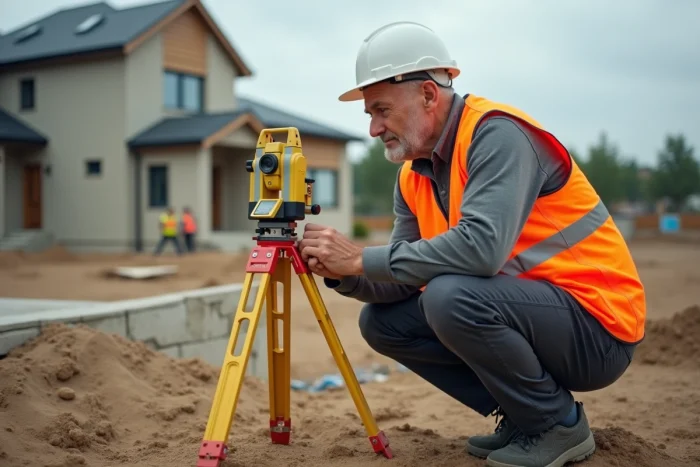
The land surveyor does not only intervene to set boundary markers. Their responsibility engages the legal security of a real estate operation from the land stage, well before the first shovel hits the ground. Understanding the technical and regulatory scope of their missions avoids additional costs and blockages that we regularly observe on poorly prepared projects.
BIM Surveys and Point Clouds: The Technical Mission Ignored by Popular Articles
The digitization of existing buildings has become a standalone service for surveying firms. Since the gradual implementation of the Climate and Resilience Law, heavy renovation or elevation projects require 3D surveys usable in BIM models. This data feeds into energy audits, thermal bridge calculations, and renovation simulations.
The Order of Land Surveyors reports a significant increase in demand for point cloud surveys, particularly in collective housing. The terrestrial laser scanner produces millions of coordinates in just a few hours, with millimeter precision that neither an old architect’s plan nor a simple manual measurement can achieve.
For a project owner, relying on the expertise of the Betard firm for this type of service guarantees a reliable geometric foundation before any thermal or structural modeling. Without this foundation, measurement errors propagate throughout the entire design chain.

Contradictory Boundary Setting and Evidential Value in Courts
A boundary plan established by a land surveyor remains the only document that serves as proof to set property limits in case of judicial dispute. The Court of Cassation reiterated this in a ruling dated December 14, 2023 (3rd civ., n° 22-18.641): a simple sketch is not sufficient to legally secure a project. The High Court annulled a decision based on a non-contradictory plan.
Contradictory boundary setting requires the summoning of all neighboring property owners, verification of property titles and the cadastral records, followed by the drafting of a report signed by the parties. This formality is not trivial. It conditions the admissibility of evidence before the judge.
Direct Consequences on a Real Estate Project
Without prior boundary setting, a construction may encroach on the neighboring land by a few centimeters, which opens the right to a demolition action. We systematically recommend boundary setting before any building permit application on a parcel whose limits have never been marked.
- Verification of titles and existing surveying documents for land publicity
- Placement of physical markers with georeferenced coordinates linked to the national system
- Drafting of the boundary report, a document enforceable against third parties once published
Parcel Division and Co-ownership: Regulatory Obligations of the Land Surveyor
Any land division with a view to selling a building lot must go through a survey document established by a land surveyor. This modifying document of the cadastral parcel (DMPC) is submitted to the cadastral service to create new parcel references. Without it, the notary cannot publish the deed of sale.
In co-ownership, the situation becomes more complex. The descriptive state of division (EDD) defines the lots, shares, and common areas. When an owner wishes to divide a lot, elevate a building, or convert attics into housing, a modification of the EDD must be drafted by a land surveyor. This modification requires a vote in the general assembly, which necessitates preparing a solid technical file to convince the co-ownership syndicate.
Volumetry and Vertical Co-ownership
In mixed operations (ground-floor shops, housing on upper floors, underground parking), division into volumes sometimes replaces classic co-ownership. The land surveyor then defines interlocking volumes in three dimensions, each constituting an autonomous property with its own management rules. This technique, common in urban development zones (ZAC) and urban renewal programs, requires a combined mastery of land law and spatial modeling.
Topography and Placement Before Construction: Precision and Compliance with Permits
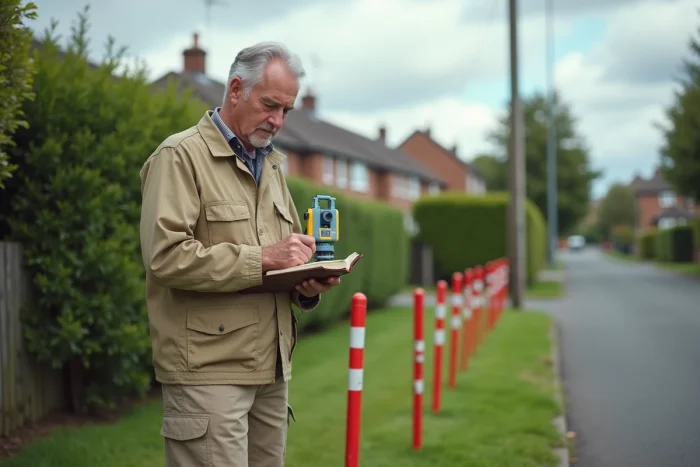
The topographic survey translates the relief, existing networks, and built elements of a parcel into an altimetric plan usable by the architect. An error of a few centimeters on an altimetric level can invalidate a building permit, especially when the local urban plan imposes a maximum height calculated in relation to the natural ground.
Placement is the inverse mission: the land surveyor transfers the dimensions of the authorized site plan onto the ground. They materialize the footprint of the building, the setbacks from the property boundaries, and the reference levels. This service occurs before excavation and constitutes the first physical act of the construction site.
- Planimetric and altimetric survey linked to the general leveling of France (NGF)
- Placement of the axes and angles of the building with centimeter tolerance
- Compliance check after the structural work, comparing the actual construction to the granted permit
A land surveyor who intervenes both in the initial survey and in the placement ensures the consistency of the data throughout the project. Entrusting these two missions to different providers multiplies the risks of discrepancies between the plan and the constructed reality.
Engaging a firm of land surveyors is not merely an administrative formality among others. It is a technical and legal safeguard that protects the project owner at every stage, from raw land to the acceptance of the work. A real estate project launched without this precision foundation exposes its holder to lengthy disputes and costly corrections on site.